
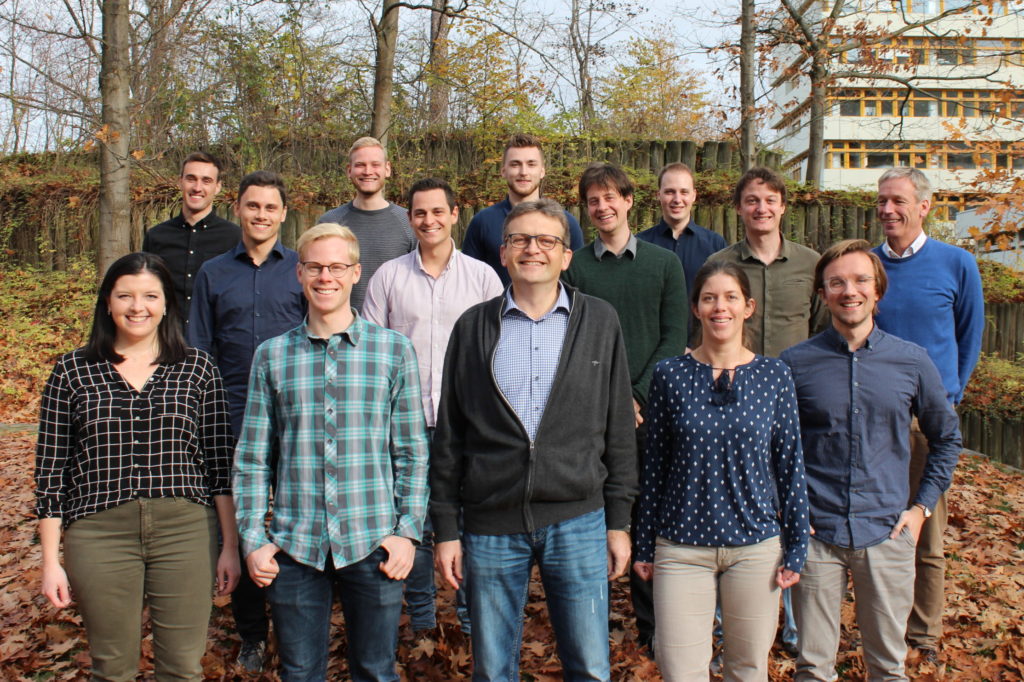
The Nanostructured Materials group at the Institute for General Materials Properties works on the generation of nanoscaled microstructures and their effects on the properties of metallic materials. The main focus lies on the mechanical properties and the resulting deformation mechanisms. To create those nanostructures, mainly high deformation processes are used. The Accumulative Roll Bonding (ARB) process in particular is used extensively to produce nanostructured sheet metal materials. This process also allows material properties to be refined or specifically tailored. In addition to generation of monolithic nanostructured materials, the ARB process also offers the possibility to produce so-called Laminated Metallic Composites (LMCs). Using this processing route, chemically different materials are combined to form a laminate in the ARB process. Subjects of current research activities are mainly on the dependence of the properties of the LMCs on the choice of constituents and the corresponding laminate architecture. The goal of the research is to develop a deeper understanding of the correlation between nanostructure, mesostructure and the resulting properties. Microscopic and analytical methods, such as light microscopy, scanning electron microscopy and transmission electron microscopy, are used intensively to examine nano- and mesostructures. Mechanical testing on the nano- as well as macro-scale under monotonic and cyclic loading (at different temperatures and deformation rates if applicable) then allows to draw correlations between mechanical properties and deformation mechanisms on the one hand and the nano- and mesostructures on the other hand.

Prof. Dr.-Ing. Heinz Werner Höppel
Department of Materials Science and Engineering
Chair of General Materials Properties
- Phone number: +49 9131 85-27503
- Email: hwe.hoeppel@fau.de

Sebastian Vollath, M. Sc.
Department of Materials Science and Engineering
Chair of General Materials Properties
- Phone number: +49 9131 85-27474
- Email: sebastian.vollath@fau.de
→ more information
- , , , , :
Deformation mechanisms and strain rate sensitivity of bimodal and ultrafine-grained copper
In: Acta Materialia 186 (2020), p. 363-373
ISSN: 1359-6454
DOI: 10.1016/j.actamat.2019.12.044 - , , , :
The Role of Interfaces on the Deformation Mechanisms in Bimodal Al Laminates Produced by Accumulative Roll Bonding
In: Advanced Engineering Materials (2020)
ISSN: 1438-1656
DOI: 10.1002/adem.202000145 - , , , :
Nanostructured Metallic Materials and Composites: Processes, Properties and Microstructures
In: Advanced Engineering Materials 21 (2019), Article No.: ARTN 1801073
ISSN: 1438-1656
DOI: 10.1002/adem.201801073 - , , , , :
Quasi-Stationary Strength of ECAP-Processed Cu-Zr at 0.5 T-m
In: Metals 9 (2019)
ISSN: 2075-4701
DOI: 10.3390/met9111149 - , , , , :
Strain Rate Contribution due to Dynamic Recovery of Ultrafine-Grained Cu-Zr as Evidenced by Load Reductions during Quasi-Stationary Deformation at 0.5 T-m
In: Metals 9 (2019)
ISSN: 2075-4701
DOI: 10.3390/met9111150