
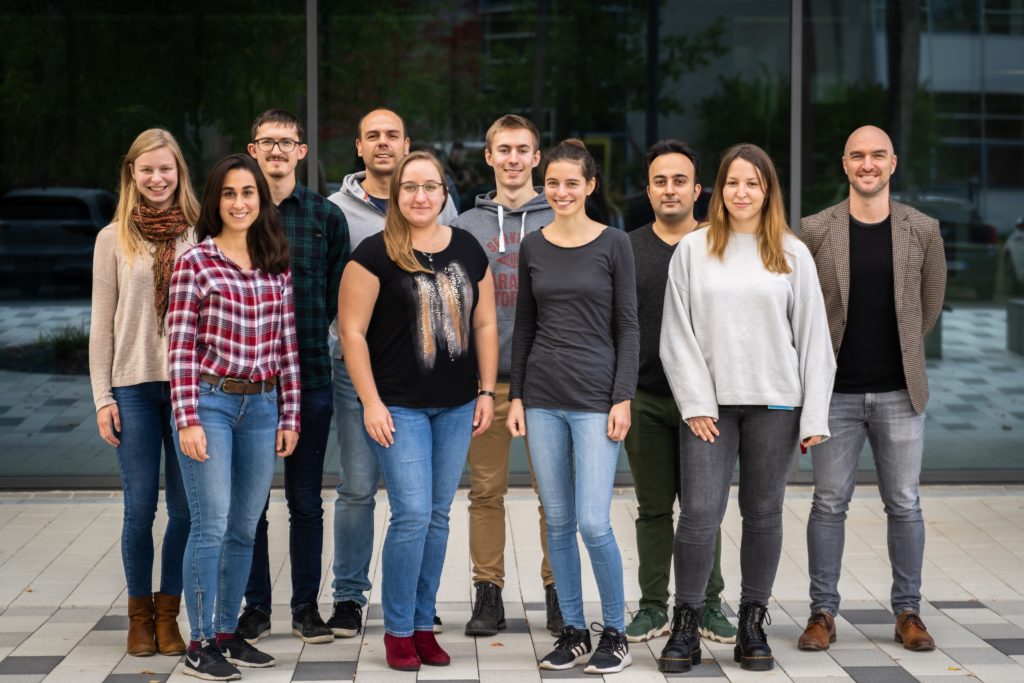
The research in Prof. Felfer’s group can be broadly summarized as instrument and technique/method development to enable new processing methods, multi-scale characterization and understanding of industrially relevant materials. We use our expertise atom probe tomography (APT), computer aided design (CAD), field ion microscopy (FIM), focused ion beam/scanning electron microscopy (FIB/SEM) and extrusion 3D printing to study a variety of topics and material classes important to the automotive, energy, geoscience and aerospace fields. If a research question cannot be answered with currently available characterization tools, we design and build components, testing stations, transfer systems and sometimes even whole instruments to make it possible. Our current research fields include hydrogen embrittlement, using FIM to study nanoparticles, cost-effective 3D printing of metals and the characterization of energy materials (e.g. fuel cells, catalysts).

Prof. Dr. Peter Felfer
Department of Materials Science and Engineering
Chair of General Materials Properties
- Phone number: +49 9131 85-27505
- Email: peter.felfer@fau.de

Mehrpad Monajem, M. Sc.
Department of Materials Science and Engineering
Chair of General Materials Properties
- Phone number: +49 9131 85-25449
- Email: mehrpad.monajem@fau.de

Nora Vorlaufer
Department of Materials Science and Engineering
Chair of General Materials Properties
- Phone number: +49 9131 85-25449
- Email: nora.vorlaufer@fau.de

Benedict Ott, M. Sc.
Department of Materials Science and Engineering
Chair of General Materials Properties
- Phone number: +49 9131 85-70455
- Email: benedict.ott@fau.de

Jan-Oliver Hücking, M. Sc.
Department of Materials Science and Engineering
Chair of General Materials Properties
- Phone number: +49 9131 85-27481
- Email: jan-oliver.h.huecking@fau.de
→ more information
→ more information
→ more information
→ more information
→ more information
- , , , , , , , , , , , , , , :
Ag2Cu2O3- a catalyst template material for selective electroreduction of CO to C(2+)products
In: Energy and Environmental Science 13 (2020), p. 2993-3006
ISSN: 1754-5692
DOI: 10.1039/d0ee01100b - , , , , , , , , , :
Combining Experiments and Atom Probe Tomography-Informed Simulations on γ′ Precipitation Strengthening in the Polycrystalline Ni-Base Superalloy A718Plus
In: Advanced Engineering Materials (2020)
ISSN: 1438-1656
DOI: 10.1002/adem.202000149 - , , , , :
Impact of the Co/Ni-Ratio on Microstructure, Thermophysical Properties and Creep Performance of Multi-Component γ′-Strengthened Superalloys
In: Crystals 10 (2020), p. 1058
ISSN: 2073-4352
DOI: 10.3390/cryst10111058 - , , , :
Indium and antimony distribution in a sphalerite from the “burgstaetter gangzug” of the upper harz mountains pb-zn mineralization
In: Minerals 10 (2020), p. 1-19
ISSN: 2075-163X
DOI: 10.3390/min10090791 - , , , , , , :
Magnetic dilution by severe plastic deformation
In: AIP Advances 10 (2020), Article No.: 015210
ISSN: 2158-3226
DOI: 10.1063/1.5128058